Underground mining involves the extraction of minerals and resources from beneath the Earth’s surface. Various methods are employed to access and recover these valuable materials. Here are some common underground mining methods:
Room and Pillar Mining
Room and pillar mining is a conventional underground mining method that is commonly used for extracting coal, salt, and various other minerals. Here’s an overview of the Room and Pillar Mining method:
Description:
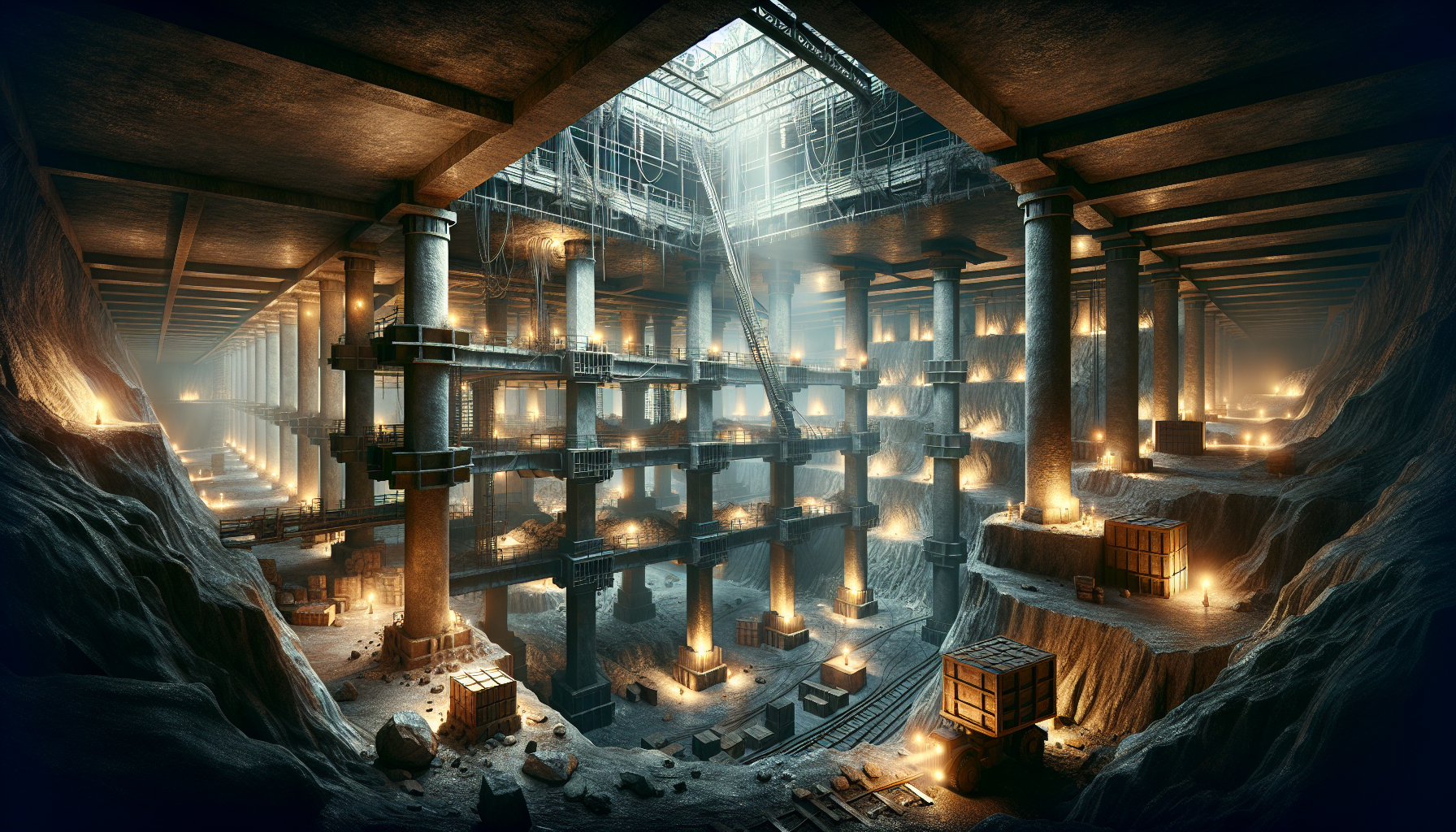
In Room and Pillar Mining, the underground deposit is extracted by creating a series of rooms or chambers separated by pillars of undisturbed material. The layout resembles a grid, where the rooms are the open areas, and the pillars act as support for the overlying rock or material.
Process:
- Development of the Mine:
- The process begins with the development of the mine workings, including the excavation of access tunnels and main entries into the deposit.
- Creation of Rooms:
- The deposit is then divided into a series of rectangular or square rooms. These rooms are excavated to extract valuable minerals or resources.
- Leaving Pillars:
- Pillars of the original material are intentionally left in place to provide structural support to the roof and prevent collapses. The size and spacing of these pillars depend on various factors, including the geology of the deposit.
- Extraction of Mineral:
- The mineral or ore is extracted from the rooms using various methods such as drilling, blasting, and mechanical loading.
- Roof Support:
- The remaining pillars play a crucial role in supporting the roof of the underground workings. This helps to prevent cave-ins and ensures the stability of the mine.
Advantages of Room and Pillar Mining:
- Selective Mining:
- Allows for selective mining of high-grade ore while leaving lower-grade material as pillars.
- Stability:
- The pillars provide stability to the underground workings, reducing the risk of collapses.
- Adaptability:
- Suitable for deposits with irregular shapes or varying thicknesses.
- Safety:
- Generally considered a safer method compared to some other underground mining techniques.
Challenges:
- Recovery Efficiency:
- Recovery efficiency may be lower than in some other mining methods, as significant portions of the deposit may be left as pillars.
- Pillar Design Complexity:
- Designing the size and spacing of pillars requires careful consideration of geotechnical factors to ensure stability.
- Waste Management:
- Managing the waste material generated during extraction can be a logistical challenge.
Room and Pillar Mining is particularly well-suited for relatively flat-lying deposits where the ore body is not too thick. It is a versatile method that has been used for many decades, especially in coal mining operations.
Sublevel Stoping
Sublevel stoping is an underground mining method commonly employed to extract valuable ore from steeply-dipping ore bodies. It is a versatile and efficient mining technique, often used for mining metallic minerals like copper, gold, silver, and lead. Here’s an overview of the Sublevel Stoping method:
Description:
In Sublevel Stoping, the ore body is divided into horizontal slices or sublevels, and each sublevel is mined progressively from top to bottom. It involves drilling and blasting operations to break the ore and transport it to the surface for processing.
Process:
- Development of Access Tunnels:
- The mining process begins with the development of access tunnels to reach the ore body. These tunnels provide entry points for miners and transportation of materials.
- The division into Sublevels:
- The ore body is divided into horizontal slices or sublevels. The spacing between sublevels depends on factors such as ore characteristics, rock mechanics, and the desired ore recovery.
- Drilling:
- Vertical or inclined blast holes are drilled from the sublevels to the ore body above. These holes are strategically placed to create a fragmented zone.
- Blasting:
- Explosives are placed in the drilled holes and detonated, breaking the ore into smaller fragments. This fragmentation allows for easier handling and transportation.
- Ore Removal:
- Once blasted, the broken ore is mucked (loaded) using equipment like loaders or trucks. The ore is then transported to the surface for further processing.
- Support Systems:
- Temporary support systems, such as rock bolts or mesh, may be installed to prevent collapses and maintain the stability of the excavation.
- Sublevel Advancement:
- The process is repeated as miners progress to lower sublevels, gradually working their way down the ore body. The method is suitable for ore bodies with a steep dip.
Advantages of Sublevel Stoping:
- Selective Mining:
- Allows for selective mining of ore zones, optimizing resource recovery.
- Efficient Ore Handling:
- The broken ore is in a convenient form for transportation and processing.
- Adaptable to Various Ore Bodies:
- Suitable for ore bodies with steep dips and irregular shapes.
- Reduced Surface Disturbance:
- Compared to some other mining methods, sublevel stoping can result in less surface disturbance.
Challenges:
- Rock Mechanics:
- The success of sublevel stoping depends on understanding and managing the rock mechanics of the ore body to prevent collapses.
- Infrastructure Development:
- Creating and maintaining access tunnels can be a significant initial investment.
- Ventilation:
- Adequate ventilation is crucial to provide fresh air to the underground workings.
Sublevel stoping is a flexible method that can be adapted to different geological conditions. It is often chosen for its efficiency in extracting ore from steeply-dipping and irregular ore bodies while allowing for selective mining.
Cut and Fill Mining
Cut and fill mining is an underground mining method used to extract ore from a steeply dipping ore body. This method is particularly well-suited for irregularly shaped ore bodies or deposits where the ore is not of uniform thickness. Cut and fill mining involves the removal of ore in horizontal slices (cuts) followed by the filling of the voids created, usually with waste rock or a combination of waste and tailings.
Description:
- Development of Access Tunnels:
- The mining process begins with the development of access tunnels and horizontal entries to reach the ore body.
- Slicing the Ore Body:
- The ore body is divided into horizontal slices or cuts. The thickness of these cuts is determined based on the mining plan and ore body characteristics.
- Drilling and Blasting:
- Holes are drilled into the rock in each cut, and explosives are placed and detonated to break the ore. The broken material is then loaded and transported to the surface.
- Extraction of Ore:
- After blasting, the broken ore is mucked (loaded) from the cut. The ore is then transported to the surface for processing.
- Void Filling:
- Once ore extraction is complete, the void left by the removed ore is filled. This filling material can include waste rock, tailings, or other backfill materials.
- Support Systems:
- Temporary support systems, such as rock bolts, mesh, or shotcrete, are often used to stabilize the walls and roof of the mined-out areas.
- Repeat Process:
- The cut and fill cycle is repeated, with miners working their way downward through the ore body. Each cut is sequentially mined and filled.
Advantages of Cut and Fill Mining:
- Selective Mining:
- Enables selective mining of high-grade ore, as cuts can be strategically placed to target specific ore zones.
- Stability:
- Provides good ground support due to the immediate backfilling of the mined-out areas, reducing the risk of collapses.
- Adaptability:
- Well-suited for irregularly shaped ore bodies or deposits with varying thickness.
- Safety:
- Considered a safer method compared to some other mining techniques due to the systematic and controlled extraction process.
Challenges:
- Costs:
- The process of drilling, blasting, and backfilling can be labour-intensive and may contribute to higher operational costs.
- Mining Recovery:
- The efficiency of ore recovery may vary depending on factors such as ore body geometry and the effectiveness of the backfilling process.
- Infrastructure:
- Requires the development of access tunnels and infrastructure for ore handling and transportation.
Cut and fill mining is often employed in situations where other mining methods may not be practical. It provides a controlled and systematic approach to ore extraction while maintaining stability and safety in the underground environment.
Block Caving
Block caving is a large-scale underground mining method that is primarily used for extracting massive, low-grade ore bodies with significant vertical extent, such as copper and gold deposits. It involves the undercutting of an ore body to induce caving, allowing the broken ore to naturally fall into a collection area below. Here’s an overview of the block caving mining method:
Description:
- Undercutting:
- The mining process begins with the creation of an artificial cavity or “undercut” at the base of the ore body. This is typically achieved by drilling and blasting or other methods to weaken the rock mass.
- Inducing Caving:
- As the ore body is undercut, the rock mass above becomes unstable, and the natural force of gravity causes it to cave or collapse. This results in the ore breaking away from the surrounding rock.
- Drawpoints:
- The broken ore, now referred to as “draw,” falls into a collection area or series of drawpoints below the undercut. These drawpoints are openings through which the ore is collected and transported to the surface for processing.
- Transportation to the Surface:
- Once collected, the ore is transported to the surface using various methods, such as conveyors, rail systems, or other material handling equipment.
- Ore Processing:
- On the surface, the collected ore is processed to extract the valuable minerals. This typically involves crushing, grinding, and separating the ore from waste material.
Advantages of Block Caving:
- High Production Rates:
- Block caving can yield high production rates, making it suitable for large, low-grade ore bodies.
- Cost-Effective:
- It is often a cost-effective method, especially for extracting low-grade deposits, as it involves minimal ore handling and transportation costs.
- Low Environmental Impact:
- Compared to some other mining methods, block caving generally has a lower environmental impact, as it minimizes surface disturbance.
- Selective Mining:
- Allows for selective mining of specific ore zones within the deposit.
Challenges:
- Geotechnical Challenges:
- Successful block caving requires a thorough understanding of the geological and geotechnical conditions to control the caving process and prevent unintended collapses.
- Ore Recovery Efficiency:
- While block caving is highly efficient, the recovery of ore can vary based on factors such as the geological structure and the control of the caving process.
- Infrastructure Development:
- The initial development of access tunnels and infrastructure for ore handling can be complex and require substantial upfront investment.
- Safety Considerations:
- Safety is a critical concern due to the potential for large-scale cave-ins. Monitoring and control measures are implemented to ensure worker safety.
Block caving is a long-term and economically viable method for mining large, low-grade ore bodies. It requires careful planning, monitoring, and control to optimize ore recovery while maintaining safety and environmental standards.
Bord and Pillar Mining
Bord and pillar mining, also known as room and pillar mining, is a method of underground mining that is commonly used for extracting coal and various other minerals. This method creates a network of rooms or chambers separated by pillars of undisturbed material to provide support. Here’s an overview of the bord and pillar mining method:
Description:
- Development of Mine Workings:
- The mining process begins with the development of access tunnels, typically referred to as entries or gate roads, to reach the ore or coal seam.
- Grid Pattern:
- The ore or coal body is then divided into a grid pattern, creating a series of rooms or chambers. The size of these rooms and the spacing of the pillars between them depend on factors such as the geological conditions, strength of the material, and the desired recovery.
- Extraction of Rooms:
- Mining operations involve the extraction of the rooms, leaving behind pillars of material to support the roof. The rooms are typically mined in a checkerboard pattern, leaving alternating squares of ore and pillars.
- Pillar Stability:
- The pillars act as a support structure to prevent the roof from collapsing. The stability of these pillars is crucial for the safety of the underground workings.
- Extraction Methods:
- Various methods can be used to extract the rooms, including drilling and blasting, continuous miners, or other specialized equipment. The broken material is then transported to the surface for processing.
- Support Systems:
- Temporary or permanent support systems, such as rock bolts, roof bolting, or other reinforcement methods, may be employed to enhance the stability of the mined-out areas.
- Repeat Process:
- The mining cycle is repeated, advancing through the grid pattern to extract additional rooms and leaving behind pillars.
Advantages of Bord and Pillar Mining:
- Selective Mining:
- Allows for selective mining of specific ore zones or coal seams, optimizing resource recovery.
- Stability:
- The presence of pillars provides stability to the underground workings, reducing the risk of roof collapses.
- Adaptability:
- Well-suited for deposits with irregular shapes or varying thicknesses.
- Safety:
- Considered a safe mining method, particularly when compared to some other underground mining techniques.
Challenges:
- Recovery Efficiency:
- Recovery efficiency may be lower than in some other mining methods, as significant portions of the deposit may be left as pillars.
- Pillar Design Complexity:
- Designing the size and spacing of pillars requires careful consideration of geotechnical factors to ensure stability.
- Waste Management:
- Managing the waste material generated during extraction can be a logistical challenge.
Bord and pillar mining is a versatile method that has been used for many years, especially in coal mining operations. The selection of this method depends on the specific characteristics of the mineral or coal deposit being mined.
Shrinkage Stoping
Shrinkage stoping is an underground mining method that involves the gradual shrinkage of the ore body as ore is removed, allowing the surrounding rock to cave in and support the excavation. This method is often used for mining narrow veins or steeply dipping ore bodies. Shrinkage stoping is characterized by a series of horizontal slices or stopes that are excavated and progressively “shrink” as the ore is extracted. Here’s an overview of the shrinkage stoping mining method:
Description:
- Access Development:
- The mining process begins with the development of access tunnels or declines to reach the ore body.
- Horizontal Slices (Stopes):
- The ore body is divided into horizontal slices, known as stopes. These stopes are typically small, narrow, and parallel to the dip of the ore body.
- Drilling and Blasting:
- Holes are drilled into the ore body within each stope, and explosives are placed and detonated to break the ore. The broken material is then loaded and transported to the surface.
- Ore Extraction:
- Once blasted, the broken ore is mucked (loaded) from the stope. The ore is then transported to the surface for further processing.
- Cave-In and Stope Shrinkage:
- After ore extraction, the void left by the removed ore allows the surrounding rock to cave in gradually. The stope “shrinks” as the surrounding rock fills the void created by ore extraction.
- Support Systems:
- Temporary or permanent support systems, such as rock bolts or mesh, may be installed to stabilize the walls and roof of the mined-out areas.
- Repeat Process:
- The shrinkage stoping cycle is repeated, with miners working their way downward through the ore body. Each stope is sequentially mined and allowed to cave in.
Advantages of Shrinkage Stoping:
- Selective Mining:
- Allows for selective mining of specific ore zones within the deposit.
- High Recovery:
- Can provide high ore recovery rates as the method facilitates efficient extraction from narrow ore bodies.
- Adaptability:
- Well-suited for steeply dipping ore bodies and irregularly shaped deposits.
- Reduced Surface Disturbance:
- Compared to some other mining methods, shrinkage stoping can result in less surface disturbance.
Challenges:
- Geotechnical Challenges:
- The success of shrinkage stoping depends on understanding and managing the rock mechanics of the ore body to control the caving process.
- Infrastructure Development:
- The development of access tunnels and infrastructure for ore handling can be complex.
- Safety Considerations:
- Safety is crucial due to the potential for cave-ins. Monitoring and control measures are implemented to ensure worker safety.
Shrinkage stoping is a method that can be efficient for extracting ore from narrow veins or steeply dipping ore bodies. It requires careful planning and execution to ensure safety and optimize ore recovery.
Vertical Crater Retreat (VCR) Mining
Vertical Crater Retreat (VCR) mining is an underground mining method primarily used for large, steeply dipping ore bodies, particularly those with tabular or pipe-like shapes. It is commonly employed in the extraction of ore deposits such as copper, nickel, and platinum. VCR mining is characterized by the creation of a vertical crater at the ore body’s bottom, allowing ore to be blasted and broken, then collected from the crater. Here’s an overview of the Vertical Crater Retreat mining method:
Description:
- Access Development:
- The mining process begins with the development of access tunnels, such as declines or shafts, to reach the ore body.
- Vertical Crater Development:
- A vertical crater is drilled or blasted at the bottom of the ore body. This crater serves as a collection point for the broken ore.
- Drilling and Blasting:
- Ore is extracted by drilling holes into the ore body above the crater and then blasting it. The broken ore falls into the crater.
- Ore Handling:
- The broken ore in the crater is mucked (loaded) using equipment like loaders or other material-handling systems. The ore is then transported to the surface for processing.
- Stope Retreat:
- The mining process involves retreating upwards, with each successive level creating a new vertical crater. This creates a series of interconnecting stopes as mining progresses.
- Stope Support:
- Support systems, such as rock bolts or mesh, are installed in the stopes to prevent collapses and ensure the stability of the mined-out areas.
- Repeat Process:
- The VCR mining cycle is repeated as miners continue to retreat upwards through the ore body, creating new craters and extracting ore.
Advantages of Vertical Crater Retreat Mining:
- Selective Mining:
- Allows for selective mining of specific ore zones within the deposit.
- High Recovery Rates:
- Facilitates high ore recovery rates as the method provides efficient extraction from steeply dipping ore bodies.
- Adaptability:
- Well-suited for ore bodies with a tabular or pipe-like shape, particularly those with steep dips.
- Reduced Surface Disturbance:
- Compared to some other mining methods, VCR mining can result in less surface disturbance.
Challenges:
- Geotechnical Challenges:
- The success of VCR mining depends on understanding and managing the rock mechanics of the ore body to control the caving process.
- Infrastructure Development:
- The development of access tunnels and infrastructure for ore handling can be complex.
- Safety Considerations:
- Safety is crucial due to the potential for collapses in the mined-out areas. Monitoring and control measures are implemented to ensure worker safety.
Vertical Crater Retreat mining is suitable for ore bodies with specific geometrical characteristics and geological conditions. It requires careful planning and execution to optimize ore recovery while maintaining safety and environmental standards.
Longwall Mining
Longwall mining is a highly productive and mechanized underground mining method used to extract coal and sometimes other minerals from a rectangular block or “longwall” of material. This method is particularly efficient for coal extraction, allowing for high recovery rates and minimal waste. Here’s an overview of the longwall mining process:
Description:
- Access Development:
- The mining process begins with the development of access tunnels, typically referred to as entries or gate roads, to reach the longwall face.
- Longwall Face Setup:
- The longwall face is set up along the coal seam. This face is usually several hundred meters long and can extend for kilometers.
- Longwall Equipment:
- Longwall mining utilizes specialized equipment, including a longwall shearer, powered roof supports, and an armored conveyor system. The longwall shearer is a large machine that moves back and forth across the coal face, cutting the coal with its powerful cutting drums.
- Coal Extraction:
- As the longwall shearer moves along the face, it cuts the coal, which is then loaded onto the armored conveyor by a face conveyor. The coal is transported out of the mine continuously.
- Powered Roof Supports:
- A series of powered roof supports, also known as shields, move forward as the longwall face advances. These supports provide immediate roof control, ensuring the stability of the working area.
- Roof Collapse:
- After coal extraction, the roof collapses behind the longwall shearer and roof supports. This controlled collapse is part of the mining process and helps to minimize subsidence at the surface.
- Waste Material and Conveyor:
- The waste material, or gob, is allowed to fall behind the longwall face. The armored conveyor transports the coal out of the mine, while the gob is pushed into the mined-out area.
- Surface Handling and Processing:
- On the surface, the extracted coal is processed and prepared for transportation and use.
- Repeat Process:
- The longwall face continues to advance, and the process is repeated, moving through the coal seam in a systematic and efficient manner.
Advantages of Longwall Mining:
- High Productivity:
- Longwall mining is highly mechanized, leading to efficient and continuous coal extraction.
- High Recovery Rates:
- Provides high recovery rates compared to some other mining methods.
- Reduced Surface Disturbance:
- Minimizes surface subsidence and disturbance due to controlled roof collapse.
- Automation:
- Longwall mining is amenable to automation, reducing the need for manual labor in certain aspects of the process.
Challenges:
- Capital Intensive:
- The initial investment in longwall mining equipment can be significant.
- Limited Applicability:
- Suited mainly for thick and flat-lying coal seams.
- Geotechnical Challenges:
- Requires careful consideration of geotechnical factors to ensure the stability of the longwall face.
Longwall mining is particularly well-suited for extracting coal from extensive and uniform coal seams. It is a continuous and highly efficient method that has been widely used in coal mining operations worldwide.
Room and Bench Mining
It seems there might be a bit of a misunderstanding in terminology. “Room and Bench Mining” is not a widely recognized or standard term in the mining industry. It’s possible that you meant “Room and Pillar Mining” or “Bench Mining.” I’ll provide a brief explanation for both:
Room and Pillar Mining:
Description: Room and pillar mining is a method used in underground mining, typically for coal or other sedimentary deposits. It involves the creation of a network of rooms or chambers separated by pillars of undisturbed material, usually made of coal.
Process:
- Access tunnels are created to reach the coal seam.
- The coal seam is divided into a grid of rectangular or square rooms.
- Pillars of coal are left to support the roof of the mined-out areas.
- Rooms are mined out, and the coal is extracted.
- The process is repeated, creating a pattern of mined-out rooms and remaining pillars.
Bench Mining:
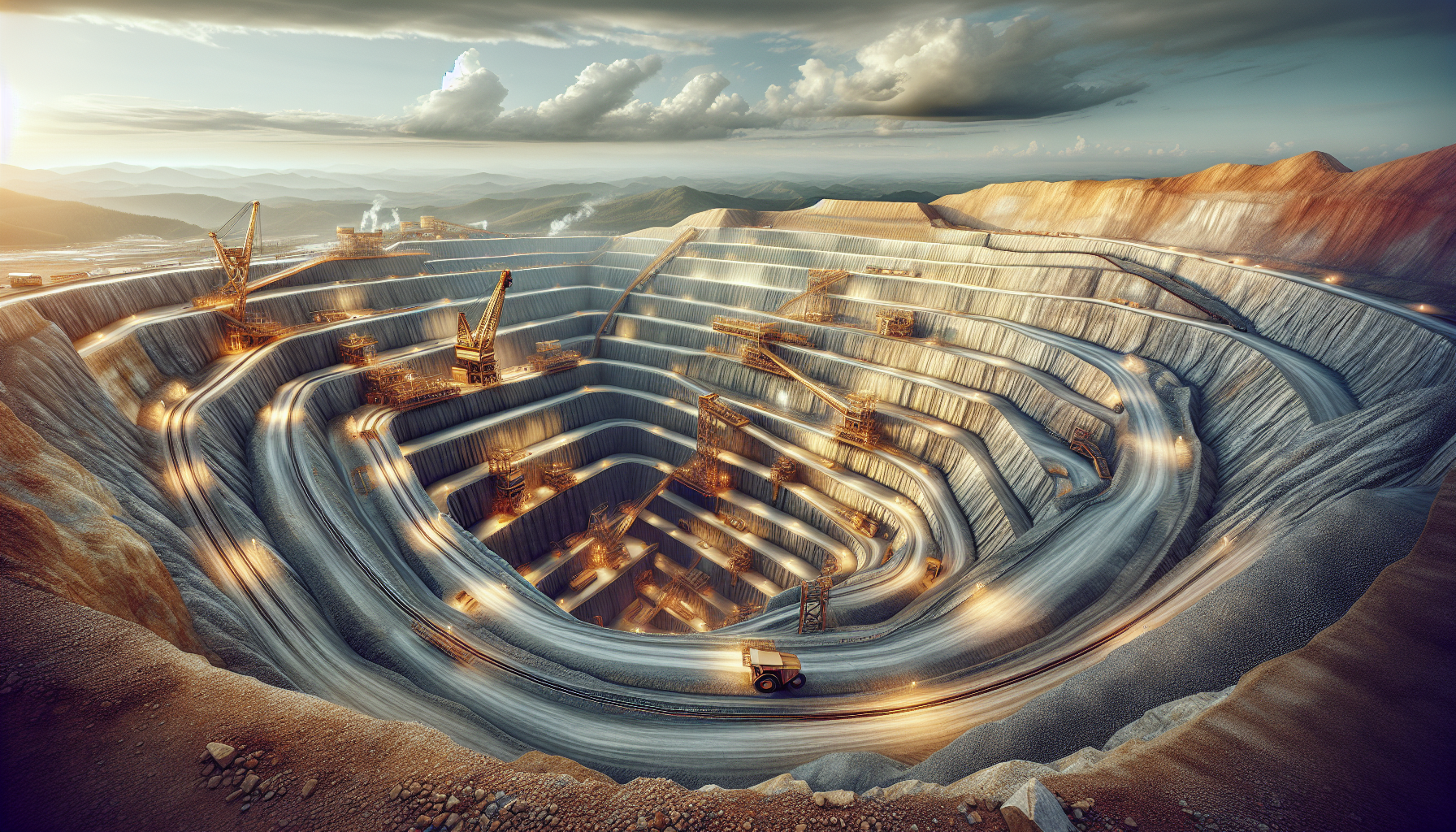
Description: Bench mining, also known as open-pit mining or open-cast mining, is a surface mining method used to extract valuable minerals or other geological materials from the earth. It involves the removal of overlying rock or soil to expose the ore or coal deposit.
Process:
- The mining area is divided into benches or steps, usually with a series of terraces.
- Overburden (soil, rock, or waste material) is removed from each bench.
- The exposed ore or coal is extracted from each bench.
- The process is repeated as mining progresses downward, creating a series of terraced benches.
If you could provide more context or clarify the specific term you are referring to, I would be happy to offer more detailed information.
Cave Mining
“Cave mining” is a term that can refer to various mining methods, and its meaning might depend on the context. Two primary types of cave mining include:
1. Block Caving:
Description: Block caving is a large-scale underground mining method used to extract valuable minerals, often metals like copper and gold. It involves the creation of an undercut or cavity beneath the ore body, causing the ore to break and cave into the void.
Process:
- A cavity (undercut) is created beneath the ore body through drilling and blasting.
- As the ore breaks away from the rock mass above, it naturally caves into the cavity.
- The broken ore is collected through drawpoints for further processing.
- The process is repeated, gradually expanding the cave.
Advantages:
- High ore recovery rates.
- Cost-effective for large, low-grade ore bodies.
- Minimal surface disturbance compared to some other methods.
Challenges:
- Requires careful control of caving to prevent unintended collapses.
- Significant upfront infrastructure development.
2. Cave Mining in Salt Deposits:
Description: In the context of salt mining, “cave mining” refers to the extraction of salt by creating underground caverns in salt deposits. This method is often used for extracting rock salt.
Process:
- Access tunnels are developed to reach the salt deposit.
- Chambers or caverns are created within the salt deposit through drilling and blasting.
- The salt is extracted from the caverns.
- The process is repeated, expanding the network of underground caverns.
Advantages:
- Efficient extraction of salt from extensive deposits.
- Can be used for both edible and industrial salt production.
Challenges:
- Control of subsidence to prevent surface disturbances.
- Management of waste material generated during mining.
In summary, “cave mining” can refer to block caving in the context of extracting metals or to the creation of underground caverns in salt deposits. Each type has its specific characteristics, advantages, and challenges, and the choice depends on the geological and economic considerations of the deposit being mined.
Discover more from AllMinings
Subscribe to get the latest posts sent to your email.