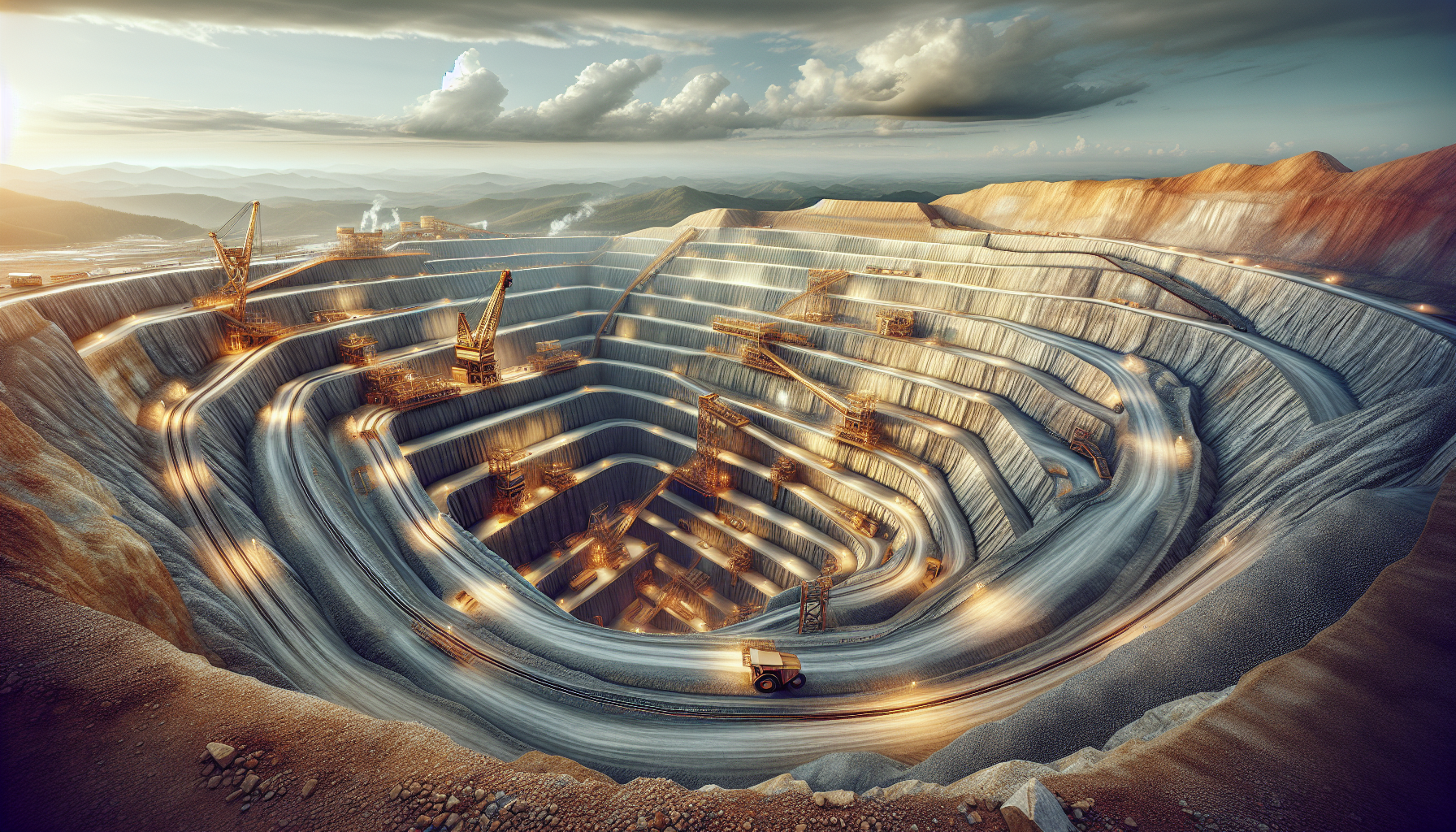
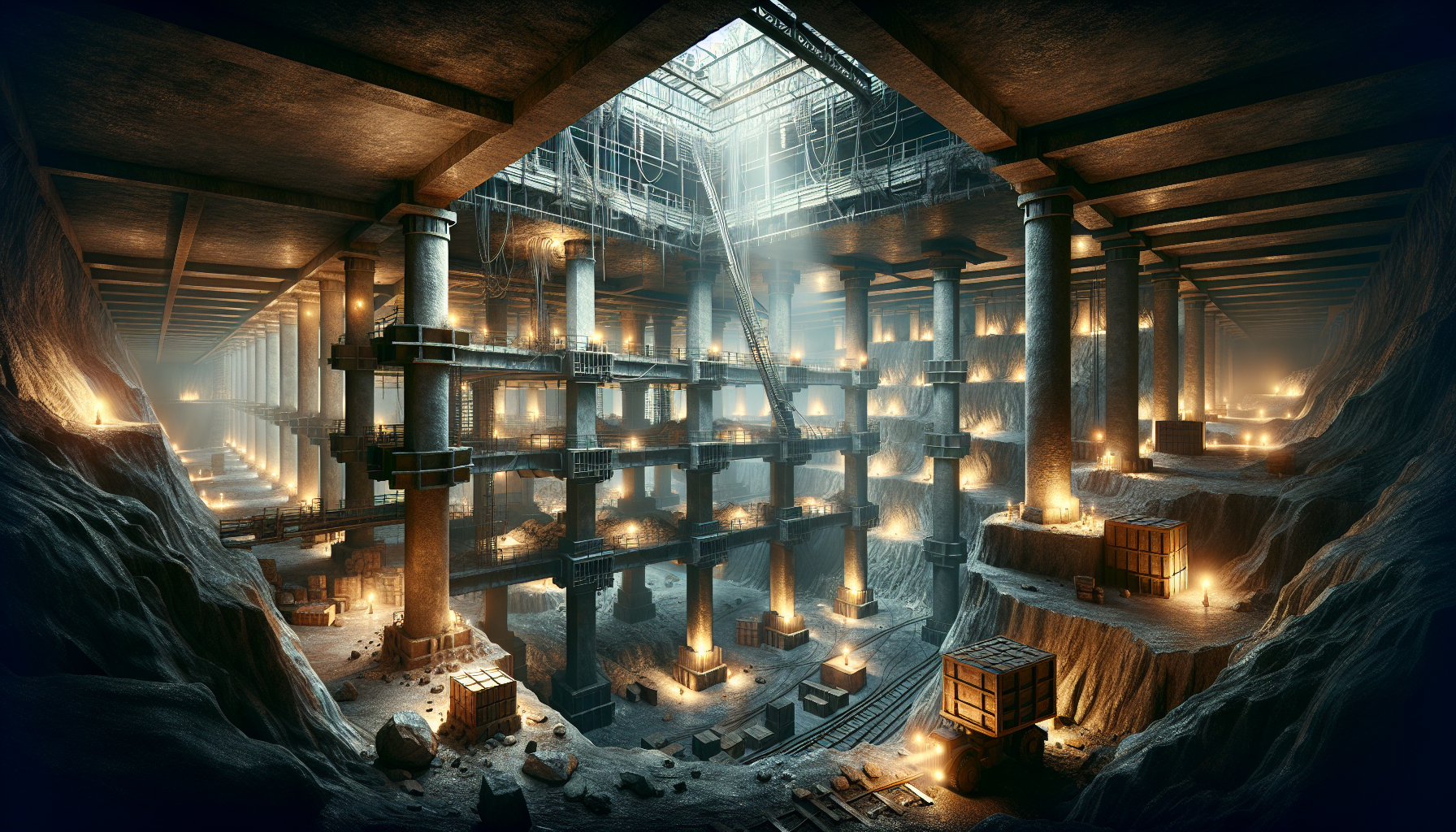
Underground mines of the mining sector, enable the extraction of valuable minerals and ores from beneath the Earth’s surface. This abstract aims to elucidate the key elements that define underground mining operations, including geological considerations, engineering challenges, and safety imperatives.
Underground mining operations hinge on a thorough understanding of geological formations. Geological surveys and assessments play a critical role in delineating ore bodies, evaluating their economic viability, and formulating optimal extraction strategies. This abstract delves into the geological intricacies that guide decision-making processes, emphasizing the importance of accurate subsurface data in shaping the trajectory of underground mining ventures.
Longwall Mining
Longwall mining is a highly productive underground coal mining technique used to extract extensive panels of coal in a single, continuous operation. It is considered one of the most efficient methods for extracting large reserves of coal from deep underground seams.
Here are the key features and steps involved in longwall mining:
Key Features:
- Shearer Machine: At the heart of longwall mining is the shearer machine, a powerful device equipped with rotating cutting drums or discs. It traverses back and forth across the face of the coal seam, cutting and loading the coal onto a conveyor system.
- Face Conveyor: This is a continuous conveyor system that moves coal from the face of the seam to a main belt conveyor for transport out of the mine. It runs parallel to the face and keeps pace with the progress of the shearer.
- Hydraulic Supports (Chocks): A series of hydraulic roof supports, also known as chocks, are installed along the face. These supports provide critical roof control, ensuring the safety of miners and allowing for controlled roof collapse behind the shearer.
- Powered Roof Supports: These hydraulic supports are advanced as the shearer moves forward, allowing the overlying strata to gradually collapse and form a controlled roof fall.
Mining Process:
- Set Up: The longwall face is prepared by installing a series of roof supports and a face conveyor. The shearer machine is then positioned at the face.
- Cutting and Loading: The shearer machine advances along the face, cutting coal and loading it onto the face conveyor. The face conveyor moves at a synchronized speed to maintain a continuous flow of coal.
- Roof Support and Collapse: As the shearer progresses, hydraulic roof supports are extended, providing critical support to the roof. This allows for controlled roof collapse, preventing unplanned roof falls.
- Conveyor Transport: Coal is transported along the face conveyor and onto the main conveyor system, which carries it out of the mine for processing.
- Advance of the Face: Once a panel of coal has been extracted, the entire longwall system is moved forward to a new mining area. This process is known as “retreating the face.”
Advantages of Longwall Mining:
- High Productivity: Longwall mining is known for its high production rates, making it an efficient method for extracting large reserves of coal.
- Minimal Surface Disturbance: Compared to other mining methods, longwall mining causes less surface disruption since most of the mining activity occurs underground.
- Enhanced Safety: The use of hydraulic roof supports and controlled roof collapses contribute to improved safety for miners.
- Economical for Deep Seams: Longwall mining is particularly well-suited for coal seams located at significant depths.
Considerations and Challenges:
- Geological Conditions: Longwall mining is most suitable for flat to gently dipping coal seams. Steeply inclined seams may require adaptations.
- Ground Control: Proper roof and floor support are essential to ensure the safety of miners and the integrity of the mining operation.
- Environmental Impacts: While surface disturbance is minimized, longwall mining can still have environmental impacts, particularly in terms of subsidence.
Longwall mining has revolutionized coal extraction, enabling the efficient recovery of substantial coal reserves from underground deposits. It is widely used in many coal-producing regions around the world.
Room and Pillar Mining
Room and pillar mining is a conventional underground mining technique used to extract coal, salt, and various other minerals. It derives its name from the methodical creation of “rooms” and “pillars” within a coal seam or mineral deposit. This method is especially effective in ore bodies with relatively flat to gently dipping formations.
Key Components:
- Rooms: These are the open spaces or chambers created within the coal or ore seam. They serve as the working areas for miners and allow for easy access to the material.
- Pillars: Pillars are solid blocks of coal or mineral left behind to provide support to the roof. They are left intact during the mining process and form a grid-like pattern that helps prevent collapses.
The Room and Pillar Mining Process:
- Initial Setup: The mining area is divided into a grid pattern, with evenly spaced pillars marked out. The size and shape of these pillars are determined based on geological conditions, including the strength of the material and the anticipated loads.
- Extraction of Rooms: Initially, rooms are mined out, typically starting from the farthest point of access. The coal or ore is extracted, leaving behind a network of interconnected rooms.
- Retention of Pillars: Pillars are intentionally left in place to support the roof and prevent it from collapsing. The size and spacing of the pillars are carefully calculated to ensure safety.
- Safety Measures: Adequate ventilation, roof bolting, and other support systems are implemented to maintain a safe working environment.
- Secondary Extraction: In some cases, after the primary extraction of rooms, additional coal or ore can be recovered by partially or fully extracting the pillars. This is known as retreat or secondary extraction.
Advantages of Room and Pillar Mining:
- Safety: Due to the systematic creation of rooms and the retention of pillars, room and pillar mining is generally considered safer than some other methods.
- Selective Mining: This method allows for selective mining of higher-grade areas within a deposit, which can increase the overall yield and economic viability of the operation.
- Minimal Surface Disturbance: Unlike some surface mining methods, room and pillar mining causes minimal disruption to the surface environment.
Considerations and Challenges:
- Efficiency: While room and pillar mining is safe, it may not be as efficient as other methods for extracting all available coal or ore, particularly in deeper or thicker seams.
- Pillar Stability: Ensuring the stability of the pillars is crucial to prevent roof collapses. This requires a thorough understanding of geological conditions.
- Resource Recovery: Depending on the layout and design, some coal or ore may be left in pillars and unrecoverable.
Room and pillar mining is widely used in coal mining operations around the world, as well as in some metallic ore mining. Its applicability depends on the specific geological conditions of the deposit and the economic considerations of the mining operation.
Sublevel Caving
Sublevel caving is a highly efficient and cost-effective underground mining method used to extract large, low-grade ore deposits situated at considerable depths. This technique is particularly well-suited for massive, tabular ore bodies with a consistent dip.
Key Features of Sublevel Caving:
- Sublevels: The ore body is divided into multiple horizontal slices or sublevels, with each sublevel connected by ramps or declines. These sublevels provide access points for mining activities.
- Gravity Flow: Ore is extracted through the force of gravity. Once broken, the material naturally falls to lower sublevels, where it can be collected for further processing.
- Fragmentation Control: The ore body is intentionally fractured to create a natural flow of material. This is often achieved through drilling and blasting.
The Sublevel Caving Process:
- Access Development: The mining area is developed with a series of ramps, declines, and drifts to provide access to the different sublevels. These are typically driven from the bottom upward.
- Sublevel Development: Horizontal drifts are created at each sublevel, establishing a network of working areas. These drifts serve as the starting point for subsequent mining activities.
- Drilling and Blasting: Holes are drilled into the ore body on each sublevel. Explosives are then used to fragment the ore. This controlled blasting creates a natural flow path for the ore to move downward.
- Gravity Flow: As the ore is blasted and fragmented, it falls by gravity to the lower sublevels, where it is collected and transported to a central point for hoisting to the surface.
- Support and Ground Control: Proper ground support measures, such as rock bolting and meshing, are implemented to ensure the stability and safety of the mining area.
- Backfilling (Optional): In some cases, the mined-out areas on upper sublevels may be backfilled with waste rock or other materials to support the stability of the overlying rock mass.
Advantages of Sublevel Caving:
- High Production Rates: Sublevel caving can achieve high production rates, making it suitable for extracting large volumes of low-grade ore.
- Minimal Infrastructure: Compared to other methods, sublevel caving requires less infrastructure, such as ventilation systems and haulage drifts.
- Cost-Effective: It is often more cost-effective than other methods for extracting low-grade ore deposits.
Considerations and Challenges:
- Geological Conditions: Sublevel caving is best suited for ore bodies with consistent characteristics and a predictable dip.
- Ground Control: Ensuring the stability of the surrounding rock mass is crucial for safety and operational success.
- Ore Recovery: While sublevel caving is efficient, some ore may be left behind in the mining process.
Sublevel caving is widely employed in mining operations, especially for extracting large quantities of ore from deep, tabular deposits. Its application is contingent on the specific geological characteristics of the ore body and the economic feasibility of the mining operation.
Block Caving
Block caving is a highly efficient underground mining method used to extract large, low-grade ore deposits situated at considerable depths. This technique is particularly well-suited for massive, tabular ore bodies that have a consistent dip.
Key Features of Block Caving:
- Undercutting: The process begins by creating an undercut beneath the ore body. This involves drilling and blasting to weaken the rock mass and initiate the collapse.
- Natural Fracturing: Once the undercut is established, the overlying rock mass starts to fracture and break due to its own weight, creating a controlled collapse.
- Gravity Flow: Ore is extracted through the force of gravity. As the rock mass above the undercut breaks and falls, it naturally flows to lower levels where it can be collected for further processing.
The Block Caving Process:
- Undercut Development: The mining area is developed with a series of ramps, declines, and drifts to provide access to the undercut level. These are typically driven from the bottom upward.
- Undercutting: Holes are drilled into the undercut level, and explosives are used to weaken the rock mass. This controlled blasting initiates the natural collapse of the overlying material.
- Fragmentation and Gravity Flow: As the ore body fractures and collapses, it falls by gravity to the lower levels, where it is collected and transported to a central point for hoisting to the surface.
- Ground Control: Proper ground support measures, such as rock bolting and meshing, are implemented to ensure the stability and safety of the mining area.
- Backfilling (Optional): In some cases, the mined-out areas on upper levels may be backfilled with waste rock or other materials to support the stability of the overlying rock mass.
Advantages of Block Caving:
- High Production Rates: Block caving can achieve very high production rates, making it suitable for extracting large volumes of low-grade ore.
- Minimal Infrastructure: Compared to other methods, block caving requires less infrastructure, such as ventilation systems and haulage drifts.
- Cost-Effective: It is often more cost-effective than other methods for extracting low-grade ore deposits.
Considerations and Challenges:
- Geological Conditions: Block caving is best suited for ore bodies with consistent characteristics and a predictable dip.
- Ground Control: Ensuring the stability of the surrounding rock mass is crucial for safety and operational success.
- Ore Recovery: While block caving is efficient, some ore may be left behind in the mining process.
Block caving is widely employed in mining operations, especially for extracting large quantities of ore from deep, tabular deposits. Its application is contingent on the specific geological characteristics of the ore body and the economic feasibility of the mining operation.
Cut and Fill Mining
Cut and fill mining is an underground mining method used to extract ore from steeply dipping ore bodies in a controlled and selective manner. It is particularly well-suited for irregularly shaped deposits or those with varying ore grades. This method involves the excavation of horizontal slices, or “cuts,” followed by the filling of the voids with waste material to provide support.
Key Features of Cut and Fill Mining:
- Selective Mining: Cut and fill mining allows for the selective extraction of ore, making it possible to target higher-grade areas within the deposit.
- Flexible Design: The method can be adapted to suit the specific characteristics of the ore body, making it applicable to a wide range of geological conditions.
- Ground Support: Ground support measures, such as rock bolting and shotcrete, are utilized to ensure the stability of the excavated areas.
The Cut and Fill Mining Process:
- Initial Setup: The mining area is divided into horizontal slices or cuts. Drifts, ramps, or declines are driven to provide access to each cut.
- Excavation of Ore: The ore within each cut is extracted, leaving behind a void. The extracted ore is then transported to the surface for processing.
- Backfilling: The void created by the ore extraction is filled with waste material, typically a combination of rock and tailings. This backfill provides support to the surrounding rock mass.
- Ground Support: Rock bolting, shotcrete, or other support measures are implemented to ensure the stability of the excavated area.
- Repeat Process: The cycle is then repeated for each subsequent cut, with additional cuts made above or below the previous ones.
Advantages of Cut and Fill Mining:
- Selective Mining: Allows for the extraction of higher-grade ore, optimizing the economic value of the mining operation.
- Ground Control: The backfilling process provides immediate support to the surrounding rock mass, reducing the risk of ground instability.
- Suitable for Irregular Deposits: Well-suited for ore bodies with irregular shapes, steep dips, or variable ore grades.
Considerations and Challenges:
- Efficiency: Cut and fill mining may not be as efficient as other methods for extracting large volumes of ore, particularly in thicker or deeper ore bodies.
- Waste Management: Proper management of waste material for backfilling is crucial for maintaining the stability of the excavated area.
- Ventilation and Access: Adequate ventilation and access are essential to ensure a safe working environment for miners.
Cut-and-fill mining is commonly used in the mining industry, especially for extracting ore from ore bodies with complex geometries. Its application is contingent on the specific geological characteristics of the deposit and the economic feasibility of the mining operation.
Shrinkage Stoping
Shrinkage stoping is an underground mining method used to extract ore from steeply dipping ore bodies. It is a labour-intensive and highly selective mining technique that involves mining in horizontal slices or levels. This method is well-suited for narrow, vertical ore bodies.
Key Features of Shrinkage Stoping:
- Selective Mining: Shrinkage stoping allows for the selective extraction of ore, targeting higher-grade areas within the deposit.
- Manual Labor: It is a labour-intensive method, with miners working in the stope to extract and load the ore.
- Ground Support: Ground support measures, such as rock bolting, timbering, or shotcrete, are used to stabilize the excavated areas.
The Shrinkage Stoping Process:
- Development of Levels: The mining area is developed with a series of horizontal levels, typically starting from the lowest level. Access is provided by declines or shafts.
- Excavation of Ore: Miners drill and blast the ore in the stope. The broken ore falls onto a draw point, from where it is manually loaded into mine cars.
- Backfilling: Once the ore is extracted, the stope is backfilled with waste rock or other suitable material. This provides support to the surrounding rock mass.
- Ground Support: Rock bolting, timbering, or shotcrete is applied as needed to ensure the stability of the excavated area.
- Repeat Process: The cycle is then repeated for each subsequent level, with additional levels developed above or below the previous ones.
Advantages of Shrinkage Stoping:
- Selective Mining: Allows for the extraction of higher-grade ore, optimizing the economic value of the mining operation.
- Ground Control: Backfilling provides immediate support to the surrounding rock mass, reducing the risk of ground instability.
- Suitable for Narrow Veins: Well-suited for ore bodies with narrow, vertical veins or shoots.
Considerations and Challenges:
- Labour Intensity: Shrinkage stoping requires a significant amount of manual labour, which can be costly and physically demanding.
- Ventilation and Access: Adequate ventilation and access are essential to ensure a safe working environment for miners.
- Waste Management: Proper management of waste material for backfilling is crucial for maintaining the stability of the excavated area.
Shrinkage stoping was historically a widely used method in mining, especially in narrow, high-grade vein deposits. However, advancements in mining technology and the development of more mechanized methods have reduced its prevalence in modern mining operations. Its application today is typically limited to specific circumstances where it remains a viable and cost-effective option.
Blasthole Stoping
Blasthole stoping is an underground mining method commonly used for extracting ore from steeply dipping ore bodies. It is an efficient and highly productive mining technique that involves drilling a pattern of holes into the ore body, loading them with explosives, and blasting to break up the material. This method is well-suited for large, tabular ore bodies.
Key Features of Blasthole Stoping:
- Efficient Extraction: Blasthole stoping allows for the efficient extraction of large volumes of ore from the ore body.
- Selective Mining: It can be adapted to selectively target higher-grade areas within the deposit.
- High Productivity: Blasthole stoping can achieve high production rates, making it suitable for economically viable operations.
The Blasthole Stoping Process:
- Development of Access: The mining area is accessed through declines, ramps, or shafts, providing entry points to the ore body.
- Drilling: Holes are drilled into the ore body in a specific pattern. These holes are typically arranged in rows and columns.
- Explosive Loading: Explosives are loaded into the drilled holes. The type and amount of explosives used are carefully calculated based on the geological conditions and desired fragmentation.
- Blasting: The explosives are detonated, causing the ore to break up into smaller pieces. This allows for easy removal and transportation.
- Mucking: The broken ore is then loaded onto mine cars or conveyed out of the stope for further processing.
- Ground Support: Ground support measures, such as rock bolting, shotcrete, or other support systems, are implemented to ensure the stability of the excavated area.
- Repeat Process: The cycle is then repeated for each subsequent section of the ore body.
Advantages of Blasthole Stoping:
- High Production Rates: Blasthole stoping is known for its high production rates, making it efficient for extracting large volumes of ore.
- Selective Mining: Allows for the extraction of higher-grade ore, optimizing the economic value of the mining operation.
- Suitable for Large Ore Bodies: Well-suited for tabular ore bodies with significant lateral extent.
Considerations and Challenges:
- Ground Control: Ensuring the stability of the surrounding rock mass is crucial for safety and operational success.
- Ventilation and Access: Adequate ventilation and access are essential to ensure a safe working environment for miners.
- Explosive Handling: Proper handling and storage of explosives are critical for safety.
Blasthole stoping is widely employed in mining operations, especially for extracting large volumes of ore from tabular deposits. Its application is contingent on the specific geological characteristics of the deposit and the economic feasibility of the mining operation. Additionally, advancements in drilling technology have enhanced the efficiency and safety of blasthole stoping.
Room and Bench Mining
Room and bench mining is an underground mining method utilized to extract valuable minerals or ores from ore bodies with a relatively flat to gently dipping configuration. This method combines elements of both room and pillar mining and sublevel caving, providing an efficient and versatile approach to ore extraction.
Key Features of Room and Bench Mining:
- Benching: Ore is extracted in horizontal slices known as benches. These benches are created by mining along a horizontal plane within the ore body.
- Room Development: Within each bench, individual rooms or chambers are excavated. These rooms provide working areas for miners and allow for easy access to the material.
- Combination Method: Room and bench mining combines the selective extraction of room and pillar mining with the controlled caving mechanism found in sublevel caving.
The Room and Bench Mining Process:
- Bench Development: The mining area is divided into horizontal benches. Ramps, declines, or drifts are driven to provide access to each bench.
- Room Excavation: Within each bench, individual rooms are created. Miners extract the ore, leaving behind pillars for support. The extracted ore is then transported to the surface for processing.
- Bench Collapse: Once the rooms within a bench are extracted, the bench is allowed to collapse under its own weight, creating a controlled caving effect.
- Ground Support: Proper ground support measures, such as rock bolting, shotcrete, or other reinforcement techniques, are applied as needed to ensure the stability of the excavated area.
- Backfilling (Optional): In some cases, the mined-out areas on upper levels may be backfilled with waste rock or other suitable material to support the stability of the overlying rock mass.
- Repeat Process: The cycle is then repeated for each subsequent bench, with additional benches developed above or below the previous ones.
Advantages of Room and Bench Mining:
- Selective Mining: Allows for the extraction of higher-grade ore, optimizing the economic value of the mining operation.
- Ground Control: The controlled caving effect provides immediate support to the surrounding rock mass, reducing the risk of ground instability.
- Versatility: Well-suited for ore bodies with relatively flat to gently dipping configurations, making it applicable to a wide range of geological conditions.
Considerations and Challenges:
- Ventilation and Access: Adequate ventilation and access are essential to ensure a safe working environment for miners.
- Waste Management: Proper management of waste material for backfilling is crucial for maintaining the stability of the excavated area.
Room and bench mining is a versatile and widely employed method in the mining industry, especially for extracting ore from ore bodies with relatively flat to gently dipping formations. Its application is contingent on the specific geological characteristics of the deposit and the economic feasibility of the mining operation.
Backfill Mining
Backfill mining is an underground mining method that involves using waste material to fill the voids created by mining, providing support and stability to the surrounding rock mass. This technique is employed to maximize resource recovery and minimize the environmental impact of mining operations.
Key Features of Backfill Mining:
- Resource Maximization: Backfill mining allows for the extraction of additional ore or coal that might otherwise be left in place to support the surrounding rock.
- Ground Support: Backfill material provides immediate support to the excavated areas, reducing the risk of ground instability.
- Environmental Considerations: This method helps mitigate the environmental impact of mining by utilizing waste material for backfilling instead of disposing of it on the surface.
The Backfill Mining Process:
- Initial Development: The mining area is accessed through declines, ramps, or shafts, providing entry points to the ore body.
- Ore Extraction: The ore is extracted using conventional mining methods, such as blasting and hauling. The extracted ore is then transported to the surface for processing.
- Backfilling: Once the ore is removed, the voids created by mining are filled with waste material, which can include rock fragments, tailings, or other suitable materials.
- Ground Support: The backfill material provides immediate support to the surrounding rock mass, reducing the risk of ground instability.
- Ventilation and Access: Adequate ventilation and access are essential to ensure a safe working environment for miners.
Advantages of Backfill Mining:
- Resource Maximization: Allows for the extraction of additional ore or coal that might otherwise be left in place to support the surrounding rock.
- Ground Control: The backfill material provides immediate support to the surrounding rock mass, reducing the risk of ground instability.
- Environmental Considerations: Helps minimize the environmental impact of mining operations by utilizing waste material for backfilling instead of disposing of it on the surface.
Considerations and Challenges:
- Backfill Material Selection: Choosing the appropriate backfill material is crucial for ensuring stability and support in the excavated areas.
- Ventilation and Access: Adequate ventilation and access are essential to ensure a safe working environment for miners.
- Regulatory Compliance: Compliance with environmental and mining regulations is important to ensure responsible and sustainable backfill mining operations.
Backfill mining is employed in various mining operations, especially in cases where it is advantageous to use waste material for stability and support. Its application is contingent on the specific geological characteristics of the deposit, as well as the economic feasibility and environmental considerations of the mining operation.
Auger Mining
Auger mining is a surface mining technique used to extract coal, minerals, and other materials from shallow, horizontal deposits, typically up to 100 feet (30 meters) deep. This method is employed when the material is too close to the surface to be economically extracted using traditional underground mining methods.
Key Features of Auger Mining:
- Surface Extraction: Auger mining is conducted entirely from the surface, making it less invasive than underground mining methods.
- Auger Machine: The primary equipment used in auger mining is the auger machine, which features a large, rotating screw or auger bit that bores into the material, breaking it up, and transporting it to the surface.
- Shallow Deposits: Auger mining is best suited for extracting materials from shallow, horizontal seams or deposits.
The Auger Mining Process:
- Site Preparation: The mining site is prepared, and the auger machine is positioned at the designated starting point.
- Auger Drilling: The auger machine is operated by a skilled operator who controls the depth and direction of drilling. The auger bit is rotated into the material, breaking it up into smaller fragments.
- Transport to the Surface: As the auger bit rotates, the broken material is transported up the screw-like structure to the surface, where it is discharged onto a conveyor or directly into trucks for transportation to processing facilities.
- Advancement: The auger machine continues to advance horizontally, extending the borehole as needed to extract the desired amount of material.
- Support and Stabilization: Adequate measures are taken to support and stabilize the borehole and surrounding area to prevent collapses or sloughing.
- Reclamation: After mining is complete, the site is reclaimed and restored according to environmental regulations.
Advantages of Auger Mining:
- Surface Operation: Auger mining is conducted entirely from the surface, minimizing the need for underground infrastructure and reducing environmental impact.
- Cost-Effective: It can be a cost-effective method for extracting shallow deposits, as it requires less equipment and infrastructure compared to deep underground mining.
- Selective Mining: Auger mining allows for selective extraction, enabling miners to target specific seams or layers.
Considerations and Challenges:
- Environmental Impact: Despite its surface nature, auger mining can still have environmental impacts, such as land disturbance and soil erosion.
- Limitation to Shallow Deposits: Auger mining is limited to shallow deposits, typically no deeper than 100 feet, which restricts its applicability.
- Ground Stability: Ensuring the stability of the borehole and surrounding area is crucial to prevent accidents and collapses.
Auger mining is employed in regions with suitable geological conditions and shallow deposits. It is typically used for extracting coal, but it can also be applied to other materials like clay, limestone, and some minerals. Its use is governed by regulations and environmental considerations to minimize its impact on the surrounding ecosystem.
Discover more from AllMinings
Subscribe to get the latest posts sent to your email.